
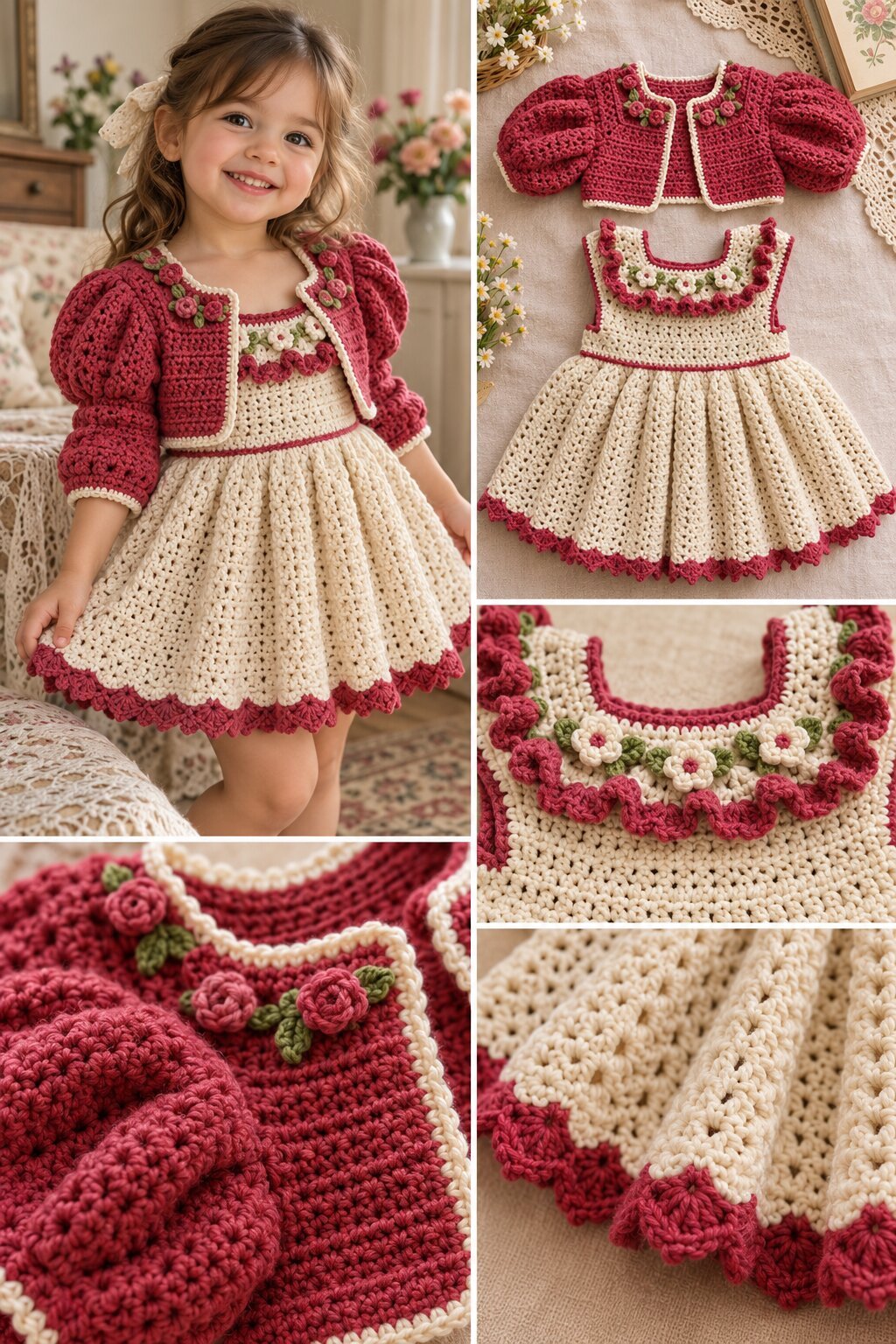
A cream sleeveless dress with a fitted yoke, a thin raspberry-red line marking the waist, and a full, gathered-looking skirt that finishes in a deep red scalloped hem. Across the chest, a ruffled red bib collar frames a row of tiny cream-and-pink flowers with green leaves. Over it goes a matching cropped bolero in the same raspberry red, with big puffed sleeves, cream edging all the way around, and little rosebud clusters stitched near the lapels. Two pieces, two colors, one coordinated look.
The color split is what makes the set work. The dress is mostly cream, so the red appears only as accents: the ruffle, the waist line, the hem. The bolero flips that, with red as the main color and cream as the outline. Each piece borrows the other’s palette in reverse, so they read as a set rather than two garments that happen to match.
This suits someone who has made a baby dress or two and wants to add a layered piece. The bolero’s puffed sleeves and the ruffled collar are the parts that ask for new skills.
Reading the Construction
The skirt fabric looks like a simple repeating cluster stitch with small gaps between the clusters, which gives it those vertical ridges and a soft, fluid drape. The ridges fan outward toward the hem, so the skirt is probably worked from the waist down with increases spaced evenly around, rather than gathered onto the yoke afterward. That would explain how smoothly the fullness flows from the waistline.
The yoke is a denser fabric, closer to single or half double crochet, which gives the bodice enough structure to hold its shape. The ruffled collar looks like a separate strip worked with several stitches into each stitch of the base row, then sewn or joined along the neckline. The flowers sit just above the ruffle, small five-petal motifs with leaves worked separately and attached.
The bolero has a different build. The puffed sleeves look like they were worked wider than the armhole and then gathered in at the cuff, which is how a crocheted fabric takes on that rounded, balloon shape. The cream trim running around the front edges and cuffs is probably a single crochet or slip stitch border added once the main pieces are joined.
Materials You’ll Need
- Cream yarn for the dress body (a soft cotton or cotton blend is a reasonable suggestion for something worn against a baby’s skin)
- Raspberry or deep rose yarn for the ruffle, waist line, hem, and bolero
- A small amount of pink yarn for the rosebuds
- A small amount of green yarn for the leaves
- A crochet hook sized to your yarn (see below)
- Yarn needle, for seaming, attaching flowers, and gathering the sleeves
- Scissors
- Stitch markers, useful for spacing the skirt increases evenly
- A tape measure or a baby sizing reference, since there’s no official size chart behind this set
- A button or snap if you want a back closure on the dress
Yarn and Hook Notes
The stitches look fairly chunky and well defined, so a DK to light worsted weight cotton or cotton blend is a sensible starting point. A hook in the 3.5mm to 4.5mm range is reasonable for that weight. Swatch the skirt’s cluster stitch before anything else, since it should look open enough to drape but not so loose that the clusters lose their shape.
For a baby garment, washability matters as much as looks. Cotton blends hold up well to repeated laundering, though the label on whichever yarn you pick has the final say.
Skill Level
This is an intermediate project. The dress is manageable for someone who has made a baby garment before, since the skirt stitch is repetitive and the yoke is plain. The extra challenge comes from the ruffled collar, the tiny flower motifs, and the bolero, which adds sleeve shaping and a gathered puff on top of a second garment. Making either piece alone would sit closer to confident beginner territory.
Stitches Likely Involved
- Chain (ch): foundation rows, flower centers, and gaps in the cluster stitch
- Slip stitch (sl st): joining, edging, and the thin waist line
- Single crochet (sc): the yoke and the trim around the bolero
- Half double crochet (hdc) and double crochet (dc): the bolero body and the skirt clusters
- A cluster or shell-type stitch: the textured skirt with its vertical ridges
- Increase (inc): flaring the skirt and widening the bolero sleeves before the cuff
- A ruffle technique: several stitches worked into each base stitch for the collar
- A small five-petal flower and a simple leaf shape: for the rosebud trim
Building It: A Practical Sequence
Start with the dress yoke. Work it in a dense stitch, sized to the baby’s chest, and check it against a reference garment before continuing.
Add the waist line in raspberry. A single round of slip stitch or single crochet in the accent color marks where the bodice ends and the skirt begins.
Build the skirt downward from the waist. Space the increases evenly, using stitch markers, so the flare looks even rather than bunching on one side.
Finish the hem with a scalloped border in red. Work shell-style stitches along the bottom edge so the contrast color shows clearly against the cream.
Make the ruffled collar as a separate strip. Work multiple stitches into each base stitch to create the wave, then attach it around the neckline.
Crochet the tiny flowers and leaves, then sew them in place above the ruffle. Lay them out first so the spacing looks even.
Work the bolero in panels. Make the back and two fronts, join at the shoulders, and add the sleeves with extra width, gathering them at the cuff to create the puff.
Trim the bolero in cream. Work a border around the front edges, hem, and cuffs, then stitch the rosebud clusters near the front opening.
Adjusting the Fit and Look
Baby sizing comes down to comparing your swatch against a garment that already fits, since no chart is provided here. The yoke and the bolero shoulders matter most for fit. The skirt is forgiving, so length can be extended or shortened just by adding or skipping rounds.
The color combination is easy to change. A navy-and-cream or sage-and-cream version would keep the same logic of one dominant color per piece. For a quicker project, leave out the ruffled collar and flowers and the dress still reads as vintage.
Where It’s Easy to Go Wrong
Uneven skirt increases. If increases drift to one side, the hem will hang crooked. Mark them at the start and check your count every few rounds.
Sleeves that puff unevenly. Gather both sleeves by the same amount at the cuff. Compare them side by side before sewing them in.
A collar ruffle that curls or flops. Too many stitches per base stitch makes it ripple too much, and too few leaves it flat. Test on a small section first.
Flowers sewn on loosely. Babies tug at small details. Stitch around each flower and make sure leaves are secured as well.
Skipping blocking on the hem. The scalloped border can look puckered off the hook. A light blocking opens it up.
Care
Hand washing in cool water and laying flat to dry is the gentler approach, especially with the sewn-on flowers and the ruffled collar. Avoid high heat, which can shrink cotton and flatten the scalloped trim. Always follow the yarn label’s care instructions, since fibers vary.
Common Questions
Is this a good first baby garment?
It’s better as a second or third. The dress alone is approachable, but the bolero’s puffed sleeves and the ruffled collar are a step up.
Can I make just the dress without the bolero?
Yes. The dress works on its own, and the bolero can be added later.
Do the flowers have to be pink and green?
No. Any small accent colors will work, as long as they sit comfortably against both the cream and the red.
How do I get the puffed sleeve shape?
Work the sleeve wider than the armhole and gather it at the cuff, so the extra fabric forms the puff.