
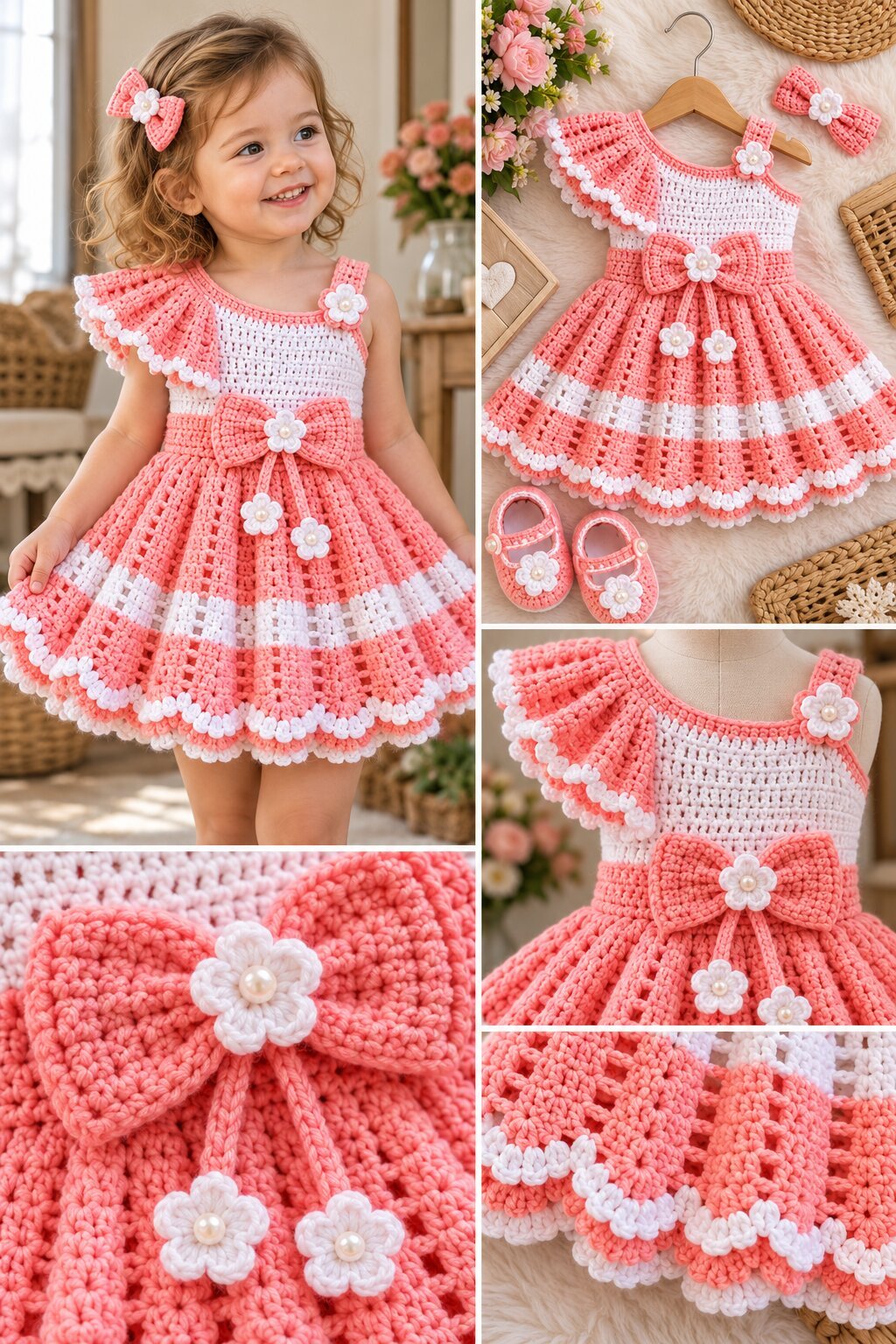
A coral and white dress with a snug white bodice, a wide coral waistband, and a full, gathered skirt. One shoulder carries a pleated, fan-shaped ruffle edged in white scallops, while the other has a narrow strap with a small white flower and a pearl-style button at its center. A large coral bow sits at the waist with two short tails, each ending in a tiny white flower. The skirt is worked in vertical ribs of coral with a band of white open stitches near the lower third, and the hem finishes in a double-layer scalloped edge of coral and white. A matching bow hair clip and a pair of Mary Jane booties appear in the flat-lay.
This post covers what the photos show and how you could build something similar. The sizes and materials below are starting points, since the images show the finished dress and not the original instructions.
How the dress is built
The photos suggest four sections, and treating them separately makes planning easier.
Bodice. The white upper section looks like a simple mesh or open double crochet grid, worked flat and fitted to the chest. The asymmetrical neckline, with one ruffled shoulder and one strap, suggests the front and back were shaped separately and joined at the sides and straps.
Waistband. A coral band sits between bodice and skirt. It looks denser than the skirt, which gives it enough structure to anchor the bow and keep the skirt from pulling on the bodice.
Skirt. The skirt appears to be worked from the waist down, with stitch groups separated by chain spaces that form vertical lines. Those lines open slightly as the skirt widens, which creates the pleated, flared look. A white band of mesh interrupts the coral partway down.
Hem. Two scalloped layers, one coral and one white, finish the edge. Each scallop looks like a small cluster of stitches worked into a single space.
The ruffled shoulder
The ruffle is the most distinctive feature. It looks like a fan or wedge worked in rows, where each row grows longer toward the outer edge, so the fabric has to pleat to fit the shoulder. A similar effect could be made by:
- Working a short, curved piece in rows, adding stitches at the outer edge only.
- Finishing the outer edge with a round of white scallops or shells.
- Sewing the inner edge to the neckline and shoulder seam, letting the fan fall naturally.
The ruffle can sit loosely or be tacked in place at two or three points to keep it from flipping forward.
The bow and flowers
The bow looks like a rectangle of dense single crochet, pinched in the middle and wrapped with a small strip. Both tails are narrow chains or slip stitch cords. The flowers appear to be five-petal motifs in white, each with a pearl-style button in the center.
A few notes for making them:
- Work the bow in a tight stitch with a smaller hook so it holds its shape.
- Make the flowers in the round, with each petal a small cluster of stitches closed by a slip stitch.
- Sew the bow and flowers on securely. See the safety section below, since these are small parts.
Yarn and hook suggestions
- Yarn: A soft cotton or cotton-blend in sport or DK weight is a sensible choice for a baby garment, since it’s breathable and washes well. You’ll need a coral shade for most of the dress and white for the bodice, band, and trim.
- Hook: A starting point is 3.0 to 4.0 mm. Use a smaller hook for the bodice so it stays firm, and a larger one for the skirt so the mesh drapes.
- Other supplies: Tapestry needle, stitch markers, buttons or pearl-style beads for the flower centers, and a snap or button for the back closure.
Swatch the bodice mesh and the skirt pattern separately, because they’ll have different gauges.
Sizing and fit
Baby and toddler sizing is where free-form designs often go wrong. Measure the child’s chest, waist, and the length from shoulder to knee, and work from those numbers rather than from age labels alone, because children of the same age vary a lot.
Some practical points:
- Keep the bodice slightly loose, since babies and toddlers need room to move.
- Add a button or tie closure at the back so the dress can get over the head.
- Make the skirt a bit longer than needed, since you can shorten it but can’t easily lengthen it.
- Leave extra length in the straps for growth.
Customization ideas
- Color: Mint with white, or pale yellow with cream, would keep the structure and change the mood.
- Sleeves: The ruffle could be made on both shoulders for a symmetrical look.
- Length: Add or remove striped bands to change the skirt length.
- Matching set: The booties and hair clip in the photos use the same coral, white, and flower accents, so a small set could be built from leftovers.
Safety notes
Baby garments need extra care with small parts. The bow, flowers, and pearl-style buttons are decorative, but they can become choking hazards if they come loose. For infants and young toddlers, replace the pearl centers with embroidered French knots, and sew every piece on with doubled thread. Check them regularly. Skip the tails and ribbons near the neckline for sleeping babies.
Care and finishing
Use machine-washable cotton or acrylic if the dress will see regular wear. Block the skirt and ruffle gently to open the stitches and set the scallops, and dry flat.
Frequently asked questions
Is this beginner-friendly?
It mixes shaping, mesh, ruffles, and small motifs, so it fits someone comfortable with garments. A simplified version with a straight bodice and plain skirt would be easier.
How much yarn will I need?
That depends on size, hook, and yarn weight. Estimate from your swatch, and buy a little extra of the main color.
Can I make the dress without the ruffle?
Yes. A simple strap on each side gives a cleaner look.
What size should I make?
Use the child’s actual measurements, and add room for growth.