
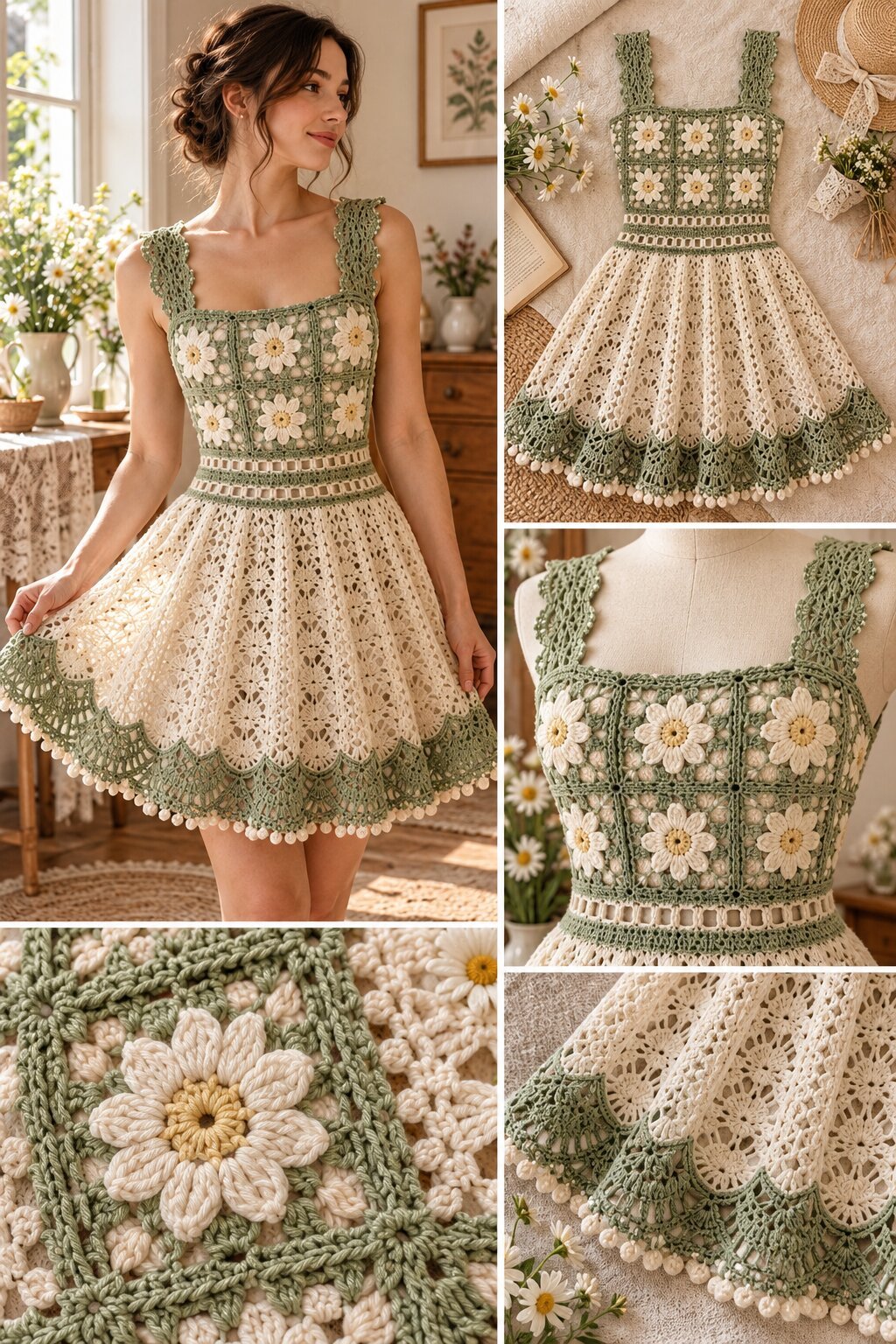
A sage-green and cream sundress with a fitted square-neck bodice and a full, flared skirt. The bodice is built from a grid of six daisy squares, three across and two down, each with a cream flower and a pale yellow center set inside a sage frame. Wide, lacy shoulder straps with a scalloped edge rise from the corners. At the waist, a narrow band of open ladder-style stitches sits between two sage borders. Below that, the skirt falls in cream openwork lace, then finishes with a deep sage scalloped border trimmed with a row of small cream beads or pompom-style balls.
This post goes through what the photos show and how you could build something similar. The numbers and materials below are starting points, since the images show the finished dress and not the original instructions.
How the dress is put together
The photos suggest four distinct sections, and thinking of them separately makes the project far more manageable.
Bodice. The flat-lay shows a grid of motifs joined edge to edge, with sage borders running between them like a window frame. The daisies sit inside the squares, so this looks like a granny-square construction, either joined as you go or sewn together afterward. Two rows of three squares fit the chest area, and the top and bottom edges are straightened with a sage border.
Waistband. A strip of open, ladder-like mesh sits between sage bands. The openings look like a row of chain spaces worked over double crochet or treble posts. It acts as a visual break between the dense bodice and the airy skirt, and it’s a good place to thread a ribbon if you want adjustable shaping.
Skirt. Cream lace with a repeating pattern of clusters and chain spaces, widening toward the hem. The flare in the photos is substantial, which means the stitch count increases at regular intervals around the circumference.
Hem border. A sage scalloped edge with fan or shell shapes, finishing in cream bobble-like beads at the points.
The daisy squares
The close-up shows a flower with about ten to twelve long, rounded petals around a yellow center, set into a sage square. The petals look like elongated clusters or tall stitches grouped in a loop. A similar effect could be built by:
- Working a small yellow center ring first, using single crochet in the round.
- Joining cream yarn and building petals as long clusters, such as a series of double or treble stitches grouped into each space, closed with a slip stitch.
- Surrounding the flower with a sage round that squares off the corners with chain spaces, then adding another sage round if you want a thicker frame.
Make one sample first and check its size. All six squares need to match exactly, or the bodice grid won’t lie flat. Aim for a square that measures roughly a third of your chest width in total, then adjust the number of squares if your bust measurement requires it.
The lace skirt
The cream lace looks like a repeated stitch pattern of small clusters separated by chains, similar to a fan or shell lace. The fullness suggests it was worked from the waist downward, in the round or in joined panels, with increases at set points to create the flare.
A practical way to approach it:
- Pick a lace stitch with a stitch multiple that divides easily into your waist measurement.
- Work increases in the pattern repeat, adding extra chains or clusters every few rounds instead of piling them into a single point.
- Block the finished skirt flat with pins, because lace relaxes and opens dramatically when blocked.
Light, drapey yarn matters here. Heavy yarn will pull the skirt down and reduce the flare.
The scalloped hem
The sage border at the bottom is the most structured part of the skirt. Each scallop looks like a fan of double or treble crochet stitches with chain spaces between them, anchored to the cream lace above. Cream bobbles, small pompoms, or beads then trim the points.
Beads are the quickest option, though they add weight and can be a concern for washing. Crochet bobbles keep the dress fully washable. Small cream puffs worked into the tips of each scallop would create a similar look.
Yarn and hook suggestions
- Yarn: A cotton or cotton-blend in fingering to light DK weight gives lace definition and holds structure. Choose cream or ecru for the skirt and flowers, sage green for the frames, border, and straps, and a pale butter yellow for the centers.
- Hook: A starting point is 2.5 to 3.5 mm, depending on yarn. The bodice should be firm, and the skirt should be loose and open. Many crocheters use a larger hook for the skirt than the bodice.
- Other supplies: Tapestry needle, stitch markers, blocking mats and pins, small cream beads or yarn for the hem trim, and optional ribbon for the waist.
Swatch both the daisy square and a lace sample before you commit. The two sections behave very differently.
Fit and customization
Because the bodice is made from modular squares, it’s easy to resize. Count how many squares you need across your bust, and adjust the number of rows of squares for your torso length. The straps should be wide enough to look intentional but light enough to avoid dragging the bodice upward. Try the finished bodice on before attaching the skirt, and check the waist position.
A few easy changes:
- Color: Swap sage for dusty blue or pale pink, and keep cream for the flowers.
- Length: Add or remove rounds before the hem border to make the dress shorter or longer.
- Lining: Because lace is see-through, wear a slip or sew in a lining.
Care and finishing
Wash flat or by hand in cool water, and dry flat. Skirt lace should be re-blocked after washing. Avoid hanging the dress on a hanger for long periods, since the weight of the skirt can stretch the shoulders.
Frequently asked questions
Can a beginner make this?
It combines granny squares, lace, shaping, and edging, so it suits someone who already feels comfortable with garments and reading lace charts.
How many squares do I need?
The photos show six, but you can make as many as your measurements require.
Do I need a lining?
Not required, but the skirt is open lace, so most people will want a slip or underlayer.
Can I make it a longer dress?
Yes. Add repeats to the skirt lace before the hem border.