
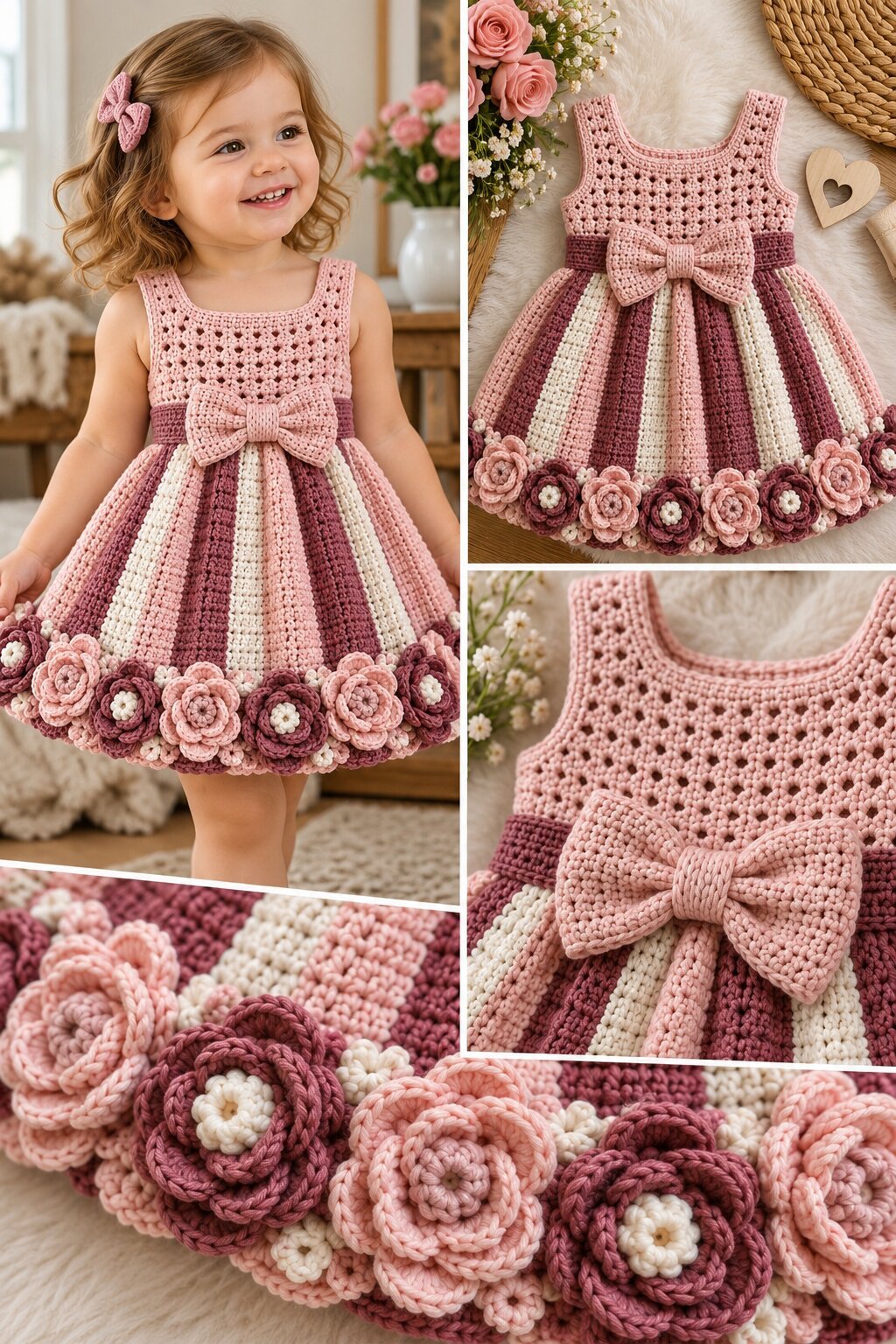
A sleeveless dress in dusty pink, deep mauve, and cream, with a scoop-neck bodice worked in an open mesh of small holes. A dark mauve waistband holds a large pink bow, and below it the skirt falls in vertical stripes: pink, mauve, cream, pink, repeating all the way around. The hem is the showpiece. A row of layered crochet roses in pink and mauve sits along the edge, with small cream flowers tucked into the gaps between them. A bow hair clip in the same pink shows up in the photos as a matching accessory.
This post covers what the photos show and how you could build something similar. The sizes and materials below are starting points, since the images show the finished dress and not the original instructions.
How the dress is built
Four sections make up the design, and planning them separately keeps the project manageable.
Bodice. The pink mesh looks like a grid of double crochet and chain spaces, with the small round holes forming a regular honeycomb pattern. The shoulder straps are wide and flat, continuing straight up from the bodice. A narrow edging round around the neckline and armholes gives a clean, slightly raised finish.
Waistband. A dense mauve band sits between bodice and skirt. It looks firmer than the skirt, which helps it anchor the bow and keeps the weight of the skirt from pulling the bodice down.
Skirt. The vertical stripes suggest the skirt was worked from the waist down in the round, with color changes at set intervals so each stripe forms a column. The fabric looks like a dense stitch, possibly single or half double crochet, with texture from working in the back loop or through a single loop. The skirt flares gently, so stitches are increased at the stripe boundaries instead of at random spots.
Hem. A band of roses and small flowers, sewn on separately or attached as you go.
Making the striped skirt
The stripes are the most structural decision. A few approaches could get you close:
- Carry colors up the inside. Work each stripe as a block of stitches, then drop the color and pick up the next. Carrying all four colors behind the work keeps the stripes sharp, but too much carried yarn can pucker the fabric.
- Use a repeating stitch count. If each stripe is, say, a set number of stitches wide, the pattern repeats cleanly and the increases fall at the same place each time. Choose a count that divides into your waist measurement.
- Place increases at stripe edges. This makes the flare look deliberate and prevents the stripes from distorting.
Swatch a few stripes in the round before committing. Color changes in the round can create a visible jog, so slip stitch and switch colors a stitch early, or use an invisible jog technique if it bothers you.
The rose border
The roses look like layered spirals: a center, then two or three rounds of overlapping petals that curl outward. Judging from the close-up, the pink roses have a lighter center with a ring of petals around it, and the mauve ones have a cream center. A comparable method:
- Crochet a long strip of chain-based loops or shells, then roll it into a spiral and stitch it in place.
- Or work separate petal rounds in the round, each one larger than the last, and stack them with the smallest on top.
- Add a small cream or pearl-colored center to each.
The cream flowers between the roses look like simple five-petal motifs, which fill the gaps and make the border look continuous. Make a few extra, since the rose sizes vary slightly and you’ll want flexibility when arranging them.
Sew the flowers on with doubled yarn through the hem fabric, anchoring each at several points so they stay upright and don’t flop forward.
The bow
The bow looks like a rectangle of dense single crochet, pinched in the center and wrapped with a small band. Use a smaller hook than the rest of the dress so it holds its shape, and stuff a tiny amount of fiberfill under the center wrap if it flattens. Sew it onto the waistband in two or three spots.
Yarn and hook suggestions
- Yarn: A soft cotton or cotton-blend in sport or DK weight suits a baby garment, since it’s breathable and washes well. You’ll need three shades: dusty pink, deep mauve or berry, and cream. Buy a bit extra of the pink, since it covers the bodice, bow, and half of the skirt stripes.
- Hook: A starting point is 3.0 to 4.0 mm. Use a smaller hook for the waistband and bow and a slightly larger one for the mesh bodice, so the holes stay open.
- Other supplies: Tapestry needle, stitch markers, small pearl-style beads or buttons for flower centers (optional), and a button or snap for the back closure.
Swatch the mesh and the striped stitch separately, because they’ll have different gauges.
Sizing and fit
For a baby or toddler dress, start with measurements instead of age labels. Measure the child’s chest, waist, and shoulder-to-knee length, then work from those numbers, since children of the same age vary a lot.
- Keep the bodice a bit loose, so there’s room for movement and growth.
- Add a back opening with a button or a few snaps so the dress can go over the head.
- Make the skirt a little longer than needed. It’s easier to shorten later.
- Leave some extra length in the straps.
Customization ideas
- Color: Sage, cream, and soft yellow would make a spring version. Navy, red, and white would read as nautical.
- Border: Fewer, larger roses create a bolder look. Smaller ones work for a delicate feel.
- Length: Adjust the number of skirt rounds before the rose band.
- Accessories: The hair bow in the photos could be made from leftover pink yarn.
Safety notes
Sewn-on roses, centers, and bows are small parts that can become choking hazards if they come loose. For infants and young toddlers, skip beaded centers, use embroidered French knots, and stitch every flower at multiple points with doubled yarn. Check them regularly. Avoid the dress for unsupervised sleep, as the bulky hem can bunch up.
Care and finishing
Choose machine-washable cotton or acrylic if the dress will be worn often. Gently block the skirt flat to even out the stripes, and shape the roses by hand while damp so the petals keep their curl. Dry flat.
Frequently asked questions
Is this beginner-friendly?
It combines mesh, color changes in the round, and dimensional flowers, so it suits someone with some garment experience. A beginner could try the bodice and skirt without the rose border.
How much yarn will I need?
That depends on size and gauge. Estimate from your swatch, and buy extra of the main pink.
Can I skip the roses?
Yes. A plain scalloped or picot edge gives a simpler finish.
Do the stripes have to be the same width?
No. Varying the widths gives a more playful effect, but keep each stripe’s stitch count consistent so increases stay tidy.