
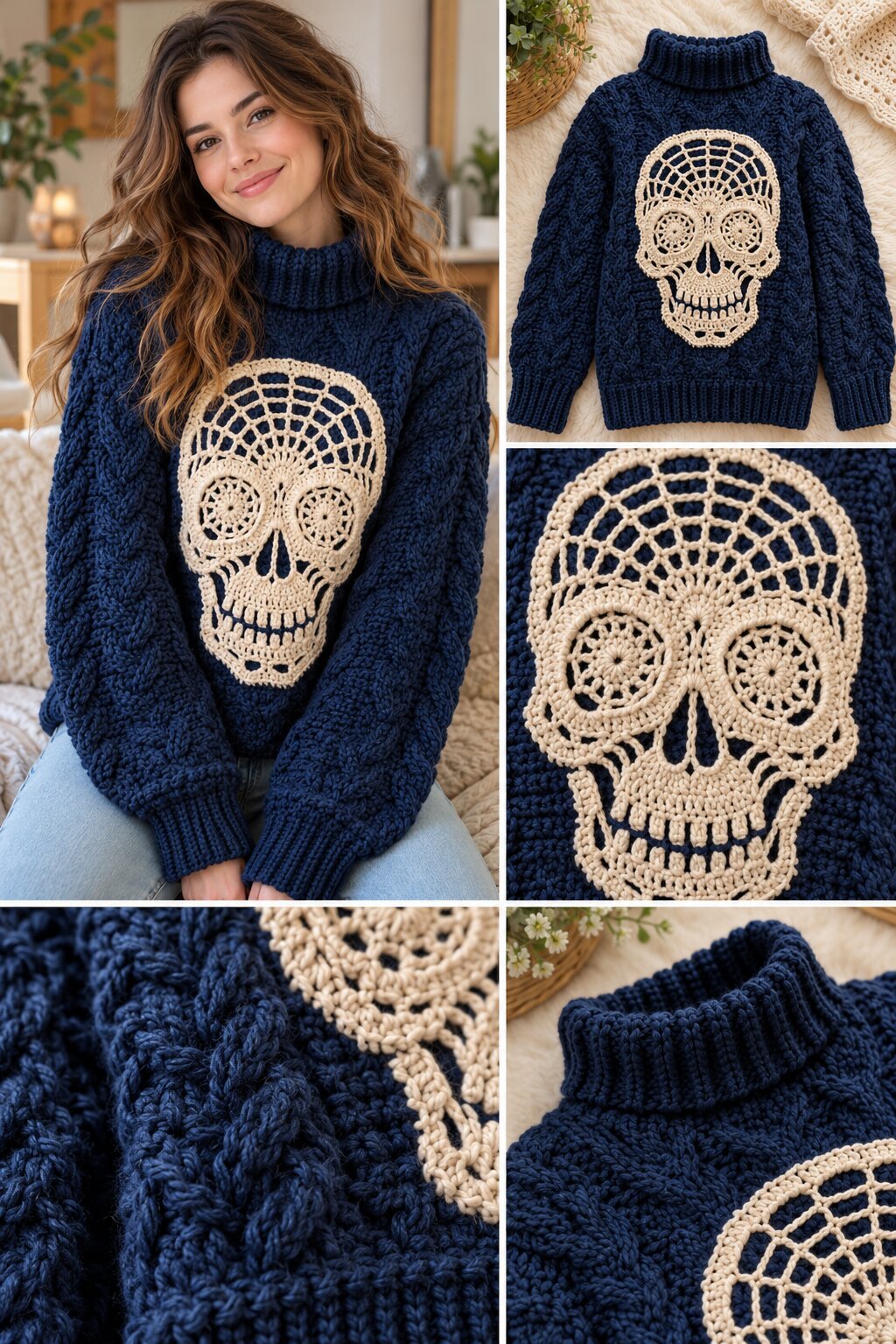
A chunky navy turtleneck pullover with a large cream skull motif covering most of the chest. The skull is a lace piece in its own right: the cranium is a web of radiating spokes and connecting rings, the eye sockets are round doily-style medallions, and the nose and teeth are picked out in denser stitching, with the navy sweater showing through the open areas. The body and sleeves carry a twisted, cable-like texture, and the neck, cuffs, and hem finish in firm ribbing.
The cream-on-navy contrast does the work here. Because the skull is open lace rather than solid fabric, the dark sweater shows through the gaps and gives the face its shadows, so the motif needs no embroidery or extra shading. It’s also the same web-and-medallion logic as a doily, just shaped into a skull.
This suits someone who has made a basic crochet pullover and wants to add an applique that needs real planning. The sweater is the long part, but the skull is the part most likely to go wrong.
Reading the Construction
The body fabric looks like a dense, raised texture with a braided or twisted rope effect, most visible on the sleeves in the close-up. That kind of texture is usually made with post stitches or a cable-style crochet technique, which also adds thickness and warmth. It would explain why the sweater looks heavy and structured rather than drapey.
The ribbing at the cuffs, hem, and turtleneck looks like crochet ribbing, probably worked in the back loop only or with alternating post stitches, which produces vertical ridges that stretch and recover. The turtleneck appears folded over, so it was probably worked tall and doubled.
The skull looks like a separate motif, made flat and stitched onto the front rather than worked into the sweater. The cranium web suggests radiating chain spokes from a center point with connecting arcs, like a spiderweb. The eye medallions look like small round motifs worked in the round with spokes, then joined into the face. The nose and teeth look like denser filet-style or solid sections.
Materials You’ll Need
- Navy bulky or chunky yarn for the sweater (a wool blend or soft acrylic is a reasonable suggestion, based on the thick, plush texture)
- Cream or ecru yarn for the skull, lighter in weight than the sweater yarn (a cotton or cotton blend gives crisp lace definition)
- Hooks sized to each yarn (see below)
- Yarn needle for seaming and applique
- Scissors
- Stitch markers, useful for tracking pattern repeats and joining points
- A tape measure, since fit depends on your own measurements
- Sewing thread in cream or navy, if you prefer to secure the applique that way
Yarn and Hook Notes
The sweater yarn looks bulky, so a hook in the 6mm to 8mm range is a reasonable place to start swatching, though textured stitches pull in, so you may need to size up. Swatch the textured stitch before anything else and wash and dry the swatch, because this much bulk can behave differently after a wash.
For the skull, a lighter cotton in DK or worsted weight with a smaller hook, around 3.5mm to 4.5mm, would give you the fine, defined lace shown. Using the same bulky yarn would make the skull heavy and lose its detail.
Skill Level
Advanced. Sweater construction in a textured stitch is its own commitment: shaping the body and sleeves, matching gauge, and working ribbing. On top of that comes a lace skull with spiderweb and medallion elements that has to be proportioned to the chest. Someone who has finished a simple pullover but never an applique motif of this size will find the skull the main new skill, and someone comfortable with doily-style lace but new to sweaters will find the garment shaping the learning curve.
Stitches Likely Involved
- Chain (ch): the web spokes and open spaces in the skull
- Slip stitch (sl st): joining, and possibly ribbing
- Single crochet (sc): the denser areas of the skull and firm edging
- Double crochet (dc) and treble crochet (tr): the arcs of the web and the sweater texture
- Front post and back post stitches (FPdc, BPdc): likely used for the cable-like texture
- Back loop only (BLO): a common way to make crochet ribbing
- Magic ring: starting the eye medallions
- Increase (inc) and decrease (dec): shaping the sweater and the skull outline
Building It: A Practical Sequence
Swatch the sweater stitch and decide your measurements first. Choose chest, length, and sleeve length from a sweater that already fits, since no size chart is provided.
Work the body and sleeves. The sweater could be worked in panels or in rounds, with the textured stitch continuing throughout. Check the fit against your reference often.
Join the pieces and add the ribbing. Hem and cuffs first, then work the turtleneck tall enough to fold over.
Plan the skull on paper before crocheting it. Sketch the outline at the size you want, marking the eyes, nose, and teeth so you can work toward a target shape.
Crochet the skull in sections. Start with the cranium web, then the two eye medallions, then the nose and teeth, joining them as you go or sewing them together afterward.
Block the skull flat and pin it to shape. Lace motifs need blocking to open the web and square up the proportions.
Place the skull on the sweater and check the position before stitching. Pin it centered, try the sweater on, and adjust. Then sew it down around the entire outline.
Adjusting the Fit and Look
Size comes from your own measurements and gauge swatch. The body can be made longer or shorter, and the sleeves adjusted the same way. The skull can be scaled up or down by changing the hook size or the number of rounds in the web.
Colors are easy to change. A black sweater with a bone-white skull would read more classically gothic, while a grey or burgundy base with a cream skull would soften the look. For a quicker version, make the skull from a simpler solid motif and leave out the web detail.
Where It’s Easy to Go Wrong
A skull that’s too small or off-center. On a bulky sweater, a small motif disappears. Pin the finished skull on the front and try the sweater on before sewing.
Lace worked too loosely. If the web sags, it won’t hold its shape against the sweater. Use a smaller hook than feels natural and block it firmly.
Skipping the swatch wash. Chunky textured crochet can grow or shrink after washing. Test it first.
Stitching the skull on too tightly. A tight seam can pucker the sweater fabric. Sew with an even, relaxed tension and check from the right side.
Ribbing that doesn’t recover. A turtleneck worked too loosely will sag. Use a smaller hook for ribbing than for the body.
Care
Hand washing in cool water and drying flat is the safest approach for a chunky textured sweater, which can stretch badly if hung wet. Avoid high heat. The cream applique may bleed or shift if the yarns differ in fiber, so test a swatch, and follow your yarn label.
Common Questions
Is this a beginner project?
No. The textured sweater and the lace skull each take real experience, and doing both is a bigger project than either alone.
Can I make the skull separately and use it on a different garment?
Yes. Since it’s a separate motif, it can go on a jacket, tote bag, or a store-bought sweatshirt.
Do I have to make the cable-like texture?
No. A plainer stitch such as half double crochet would be faster, though the texture is a big part of the cozy look.
What if my skull comes out lopsided?
Block it before attaching. Pinning the web to a symmetric outline fixes most small imbalances.