
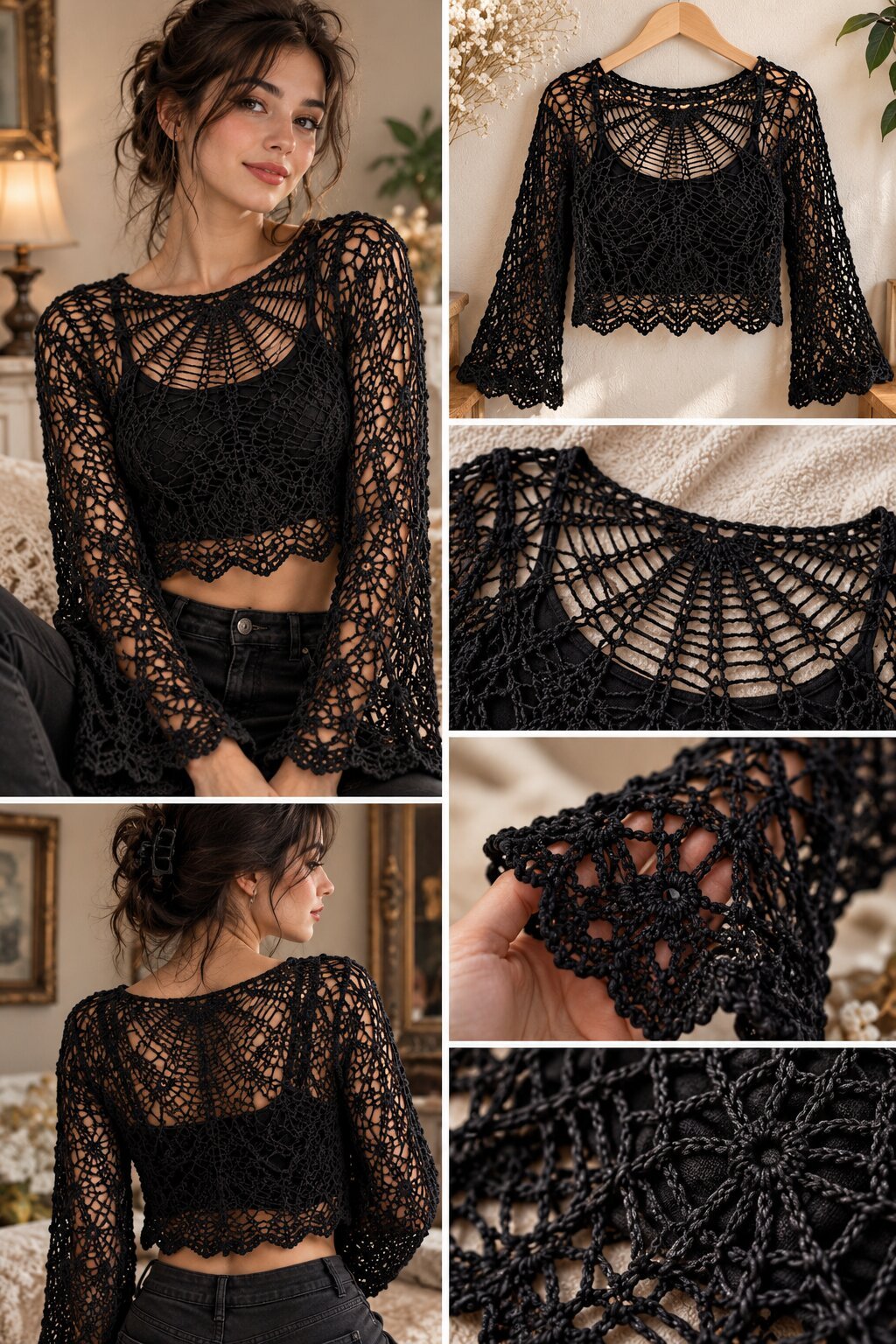
A sheer black crop sweater worked entirely in open lace, with a round neckline and long bell sleeves that flare toward the cuff. Around the neck, a fan of radiating spokes spreads across the shoulders and upper chest like a spiderweb, the clearest piece of structure in an otherwise airy fabric. Below that, the body is a network of small star-shaped medallions joined by chain links, finished at the hem and cuffs with a scalloped lace edge. It’s shown over a black camisole, which is how the design is meant to be read: the lace sits on top and the dark layer underneath gives the open stitches their depth.
Two lace textures are working together here. The neckline uses long spokes with connecting arcs, a fan or web shape, while the rest of the garment switches to a small, repeating flower-like medallion pattern. The transition happens just below the collar area, so the web reads as a yoke detail rather than a separate piece.
This suits someone who has made lace shawls or doilies and wants to turn that skill into a wearable garment. The stitch work is repetitive, but keeping a sleeve-length lace fabric even and well-fitted takes patience.
Reading the Construction
The medallion texture in the sleeves and body looks like a joined-motif or join-as-you-go pattern, small round flower shapes with chain bridges linking each one to its neighbors. That could be built from individual hexagonal or round motifs joined into a fabric, or from a continuous stitch pattern that imitates the look. A continuous pattern would be simpler to shape in a garment, while joined motifs give you the flexibility to size by counting motifs.
The neckline fan looks like it begins near the center back or front of the collar and spreads outward, probably worked from the neckline down in a yoke-style construction. That fits how the spokes widen as they move away from the neck. It also suggests the body and sleeves may continue from the yoke in the round, which keeps seams to a minimum, though a seamed construction is equally plausible.
The bell sleeves flare because the lace pattern widens toward the cuff, either through extra increases in the repeat or through larger motifs near the end. The scalloped trim along the cuffs and hem looks like a shell or picot-style border worked in a final round.
Materials You’ll Need
- Black yarn in a fine, smooth fiber (a cotton, cotton blend, or mercerized cotton is a reasonable suggestion, since it gives crisp stitch definition in lace)
- A crochet hook sized to your yarn (see below)
- Yarn needle for weaving in ends and joining motifs, if you go that route
- Scissors
- Stitch markers, useful for marking repeat points and the start of each round
- A tape measure, since fit depends on your own measurements
- A black camisole or bralette to wear underneath
Yarn and Hook Notes
The lace looks fine and delicate, so a fingering to light DK weight yarn is a sensible starting point, with a hook roughly in the 2.5mm to 3.5mm range. Open lace needs a slightly looser tension than solid fabric to keep the chain spaces airy, so swatch a few repeats and block the swatch before measuring gauge. Black yarn hides stitch definition, so work in bright light and choose a smooth yarn with a bit of twist rather than a fuzzy one.
Skill Level
Intermediate to advanced. The individual stitches are basic, but the fabric is all chain-and-space work where a miscount shows up as a misaligned medallion. The fan yoke, the sleeve flare, and keeping a full garment’s worth of lace consistent in size add to the challenge. Crocheters comfortable with doily-style charts will adapt quickly. Those new to lace may want to practice a small motif swatch first.
Stitches Likely Involved
- Chain (ch): bridges between medallions and the web spokes
- Slip stitch (sl st): joining rounds and moving across stitches
- Single crochet (sc): anchoring points in the lace and edging
- Double crochet (dc) and treble crochet (tr): the longer arcs and spokes
- Picot or shell stitch: the scalloped edge
- Magic ring: starting medallions, if using a joined-motif approach
- Increase (inc): widening the yoke and the bell sleeves
Building It: A Practical Sequence
Start by swatching the medallion lace and the web fan. Work both at the size you want, block them, and measure to plan the garment.
Decide on construction. A top-down yoke with the neckline fan first, then dividing for body and sleeves, matches what is visible. Joined motifs are the alternative if you prefer building by section.
Work the neckline fan. Increase evenly around so the spokes spread symmetrically, using markers at each spoke.
Transition into the medallion pattern for the body and sleeves. Keep the repeat count consistent so the stars line up vertically.
Shape the bell sleeves. Add extra increases or enlarge the repeat toward the cuff for the flare, and compare the two sleeves as you go.
Finish with the scalloped border at the hem and cuffs in a shell or picot round.
Weave in ends and block firmly. Lace needs pinning to open the medallions and straighten the scallops.
Adjusting the Fit and Look
Because this is an open, stretchy lace, fit is forgiving, but width and length still come from your own measurements and gauge swatch. Cropped length is easy to change by adding or skipping rounds before the border. The sleeves can be shortened to elbow length for a lighter version. Other deep colors such as burgundy or dark green would keep the gothic mood. For a faster project, work a plain mesh body and keep only the web yoke as the decorative element.
Where It’s Easy to Go Wrong
Losing the repeat. In lace, one missed chain throws off the whole pattern. Mark repeats and check your count at the end of each round.
Uneven bell sleeves. The flare can drift between sleeves. Compare them side by side every few rounds.
Tension too tight. Tight chains make the lace stiff and cramped. Use a slightly larger hook for chain spaces if needed.
Skipping blocking. Unblocked lace looks crumpled and hides the medallion shapes.
Working in poor light. Black yarn makes mistakes harder to see until they’ve compounded.
Care
Hand wash in cool water and lay flat to dry, reshaping while damp. Lace snags easily, so avoid machine washing, and don’t hang it wet, since the weight can stretch the sleeves. Follow the yarn label for fiber-specific care.
Common Questions
Is this a beginner project?
Not really. It uses simple stitches, but sustained lace patterns and garment shaping take some experience.
Do I need to wear something underneath?
It’s designed to be sheer, so a camisole or bralette is the intended styling.
Can I use a thicker yarn?
Yes, but the lace will be less delicate and the medallions will be larger, so adjust your repeat counts.
Can I skip the web neckline?
Yes. The all-over medallion lace works on its own, though the fan is a major part of the look.
SEO Title: Gothic Crochet Top Pattern: Black Lace Sweater Design
Meta Description: A sheer black crochet lace top with a spiderweb neckline, bell sleeves, and scalloped hem. Construction, yarn, and blocking tips included.
Focus Keyword: Gothic Crochet Top Pattern
Secondary Keywords: black lace crochet sweater, spiderweb crochet top, sheer crochet crop top, gothic crochet fashion, bell sleeve crochet top, crochet lace yoke, alternative crochet clothing
Suggested URL Slug: gothic-crochet-top-black-lace-sweater
Featured Image Filename: gothic-black-lace-crochet-top.jpg
Featured Image Alt Text: Sheer black crochet lace crop top with a spiderweb neckline, bell sleeves, and scalloped hem worn over a camisole
Featured Image Title: Gothic Black Lace Crochet Top
Featured Image Caption: A sheer black crochet lace top with a radiating web yoke, medallion body, bell sleeves, and scalloped edges.