
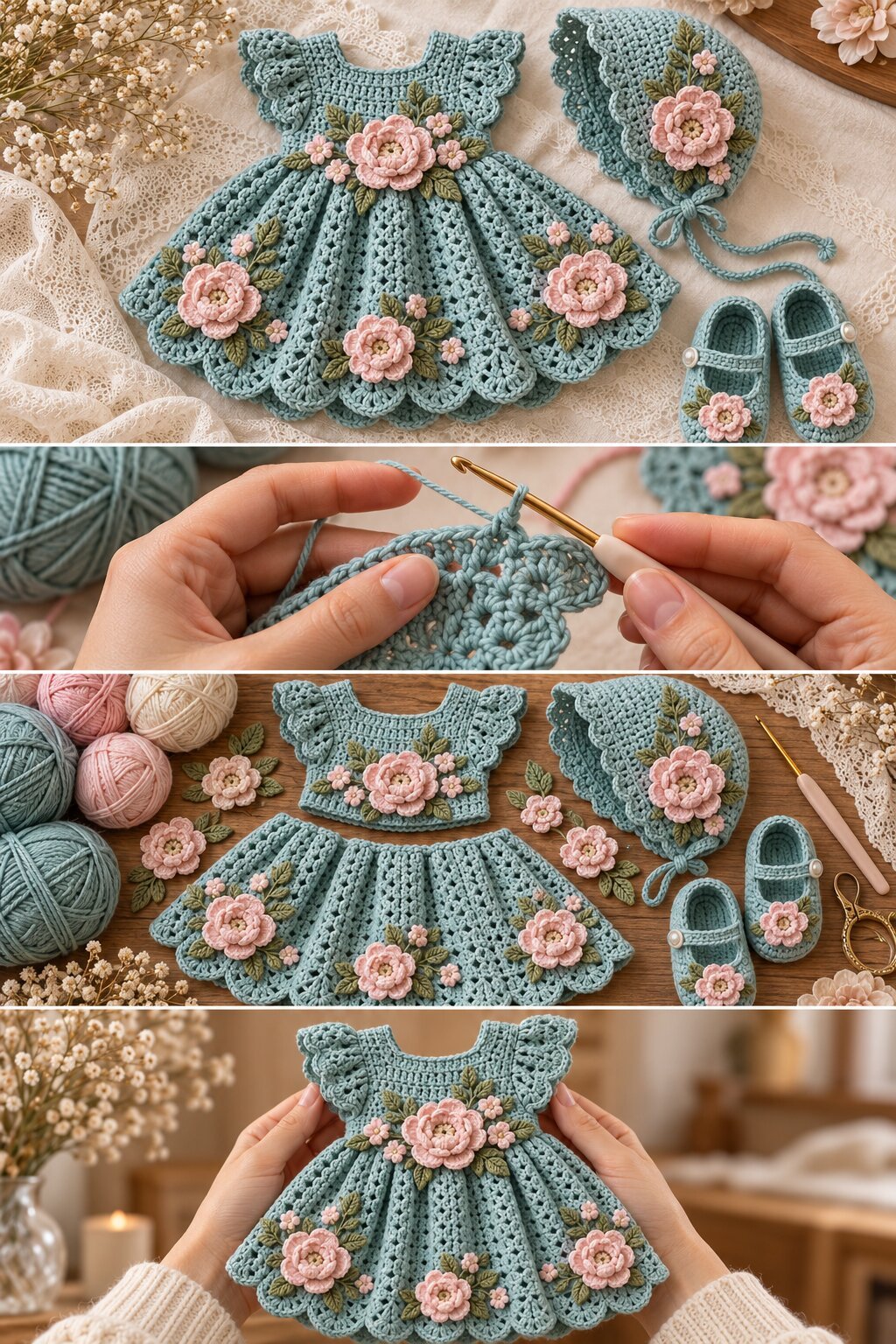
A soft blue-green baby dress lies flat with a matching bonnet and a pair of booties arranged around it. The bodice is a close mesh with a square-scoop neckline, and each shoulder carries a short flutter sleeve with a scalloped edge. Below the waist, the skirt opens into a lacy fan-and-chain pattern with visible vertical ribs, and the hem ends in deep, rounded scallops. Pink peonies with cream centers are scattered across the dress: one large bloom at the chest with small blossoms and olive-green leaves fanning on either side, and others placed low on the skirt. The bonnet repeats the motif on one side and ties under the chin with a bow. The booties are Mary Jane style, each with a strap, a button, and a small peony at the toe.
This post covers what the photo shows and how you could build something similar. The sizes and materials below are starting points, since the image shows the finished set and not the original instructions.
How the dress is built
The construction looks straightforward when you split it into parts.
Bodice. A dense, even mesh, likely rows of double crochet with chain spaces, or a tightly worked half double crochet. The neckline is a wide scoop with straight shoulder lines, and the armholes are finished with sleeve frills instead of bands.
Flutter sleeves. Each sleeve looks like a small fan: a short piece that widens toward the edge and finishes with scallops. A similar effect could be created by working a few rows that gain stitches at the outer edge, then adding a round of shells or picots. They appear to attach at the shoulder and fall loosely over the upper arm.
Waist and skirt. There’s no contrasting waistband. The skirt starts directly from the bodice and flares through regular increases. The vertical ribs suggest stitch columns, probably clusters or post stitches, separated by open chain spaces. Those columns widen as the skirt does, which creates the pleated look without actual pleats.
Hem. Large scallops, likely built from shells or fan clusters worked into the final lace round. Each scallop looks about the width of a rib group, which is why the edge feels so regular.
The peony appliqués
The peonies are the defining detail, and they’re separate pieces sewn on after the dress is finished. Judging from the photo, each one has a small center, then two or three rounds of overlapping, curled petals in two tones of pink. A similar dimensional effect could be built by:
- Starting with a tiny cream or pale yellow center worked in the round.
- Adding successive petal rounds, each with more and slightly larger petals, and each worked into the back loops or into the previous round’s stitches so the layers sit on top of each other.
- Finishing with an outer ring of loose petals that you gently curl by hand.
Leaves look like small pointed ovals in muted olive, worked in rows or around a chain foundation. Make a few extra in different sizes, because arranging them is easier when you can choose. Small five-petal blossoms in pale pink fill gaps between the large blooms.
For placement, the photo shows an asymmetric spray at the chest, centered on the large flower, and single blooms near the hem on the sides. Lay everything out with pins before sewing so the arrangement balances.
The bonnet and booties
Bonnet. A rounded cap with a scalloped brim and a long tie on each side, finished in a bow. It appears to be worked in the same mesh or lace as the dress, shaped from the crown outward in the round, then extended at the sides for the face opening. The peony spray sits on one side.
Booties. Mary Jane style, with a flat oval sole worked in the round, sides built up in tight single crochet, a cut-out front, and a strap closed with a button. A tiny peony and leaves sit at the toe.
The set works as a gift because everything is made from the same yarn and flower motif, so leftovers go a long way.
Yarn and hook suggestions
- Yarn: A soft cotton or cotton blend in sport or DK weight is a sensible choice for baby garments, since it’s breathable and washable. You’ll need a muted teal or blue-green for the dress, bonnet, and booties, plus two shades of pink, olive green, and a little cream or pale yellow for centers.
- Hook: A starting point is 3.0 to 3.5 mm for the dress, with a size smaller for the booties so the soles are firm. Use a 2.0 to 2.5 mm hook for the flowers if you want them dense.
- Other supplies: Tapestry needle, stitch markers, two small buttons for the booties, and a button or snap for the back of the dress.
Swatch the mesh and the skirt lace separately. They’ll give different gauges, and the flowers need their own sample too.
Sizing and fit
Choose a size from the child’s actual measurements, not age labels, since babies of the same age vary a lot. Measure chest, shoulder-to-waist, and shoulder-to-knee.
- Keep the bodice slightly roomy for movement and growth.
- Add a button or snap closure at the back so the dress can pass over the head.
- Make the skirt a bit longer than you think you need. Shortening is easy, lengthening is not.
- Leave the sleeve frills loose. Tight sleeves on a baby are uncomfortable.
Customization ideas
- Color: Cream with peach peonies, or soft gray with dusty rose, keeps the structure and shifts the mood.
- Flower count: One large bloom at the chest is enough for a simpler version.
- Sleeves: Leave them off and edge the armholes with a plain round of single crochet.
- Length: Add or remove rounds before the hem scallops.
Safety notes
Sewn-on flowers, leaves, buttons, and bonnet ties all need attention with babies. Stitch each flower at several points with doubled yarn, and tug gently to test them. For infants and young toddlers, skip the buttons on the booties and use a stitched strap instead. Keep bonnet ties short, and remove the bonnet during sleep. Check all appliqués regularly for loose threads.
Care and finishing
Choose machine-washable cotton or acrylic if the set will be worn often. Block the skirt and sleeve frills gently to set the scallops, and shape the peonies by hand while they’re damp so the petals keep their curl. Dry flat.
Frequently asked questions
Is this beginner-friendly?
It combines mesh, lace shaping, small garments, and layered flowers, so it suits someone with some garment experience. A beginner could make just the booties or the bonnet first.
How much yarn will I need?
That depends on size and gauge. Estimate from your swatch, and buy extra of the main color so the set matches.
Can I make the dress without the flowers?
Yes. The scalloped hem and sleeves look finished on their own.
Can I make only the bonnet?
Yes. Each piece stands alone.