
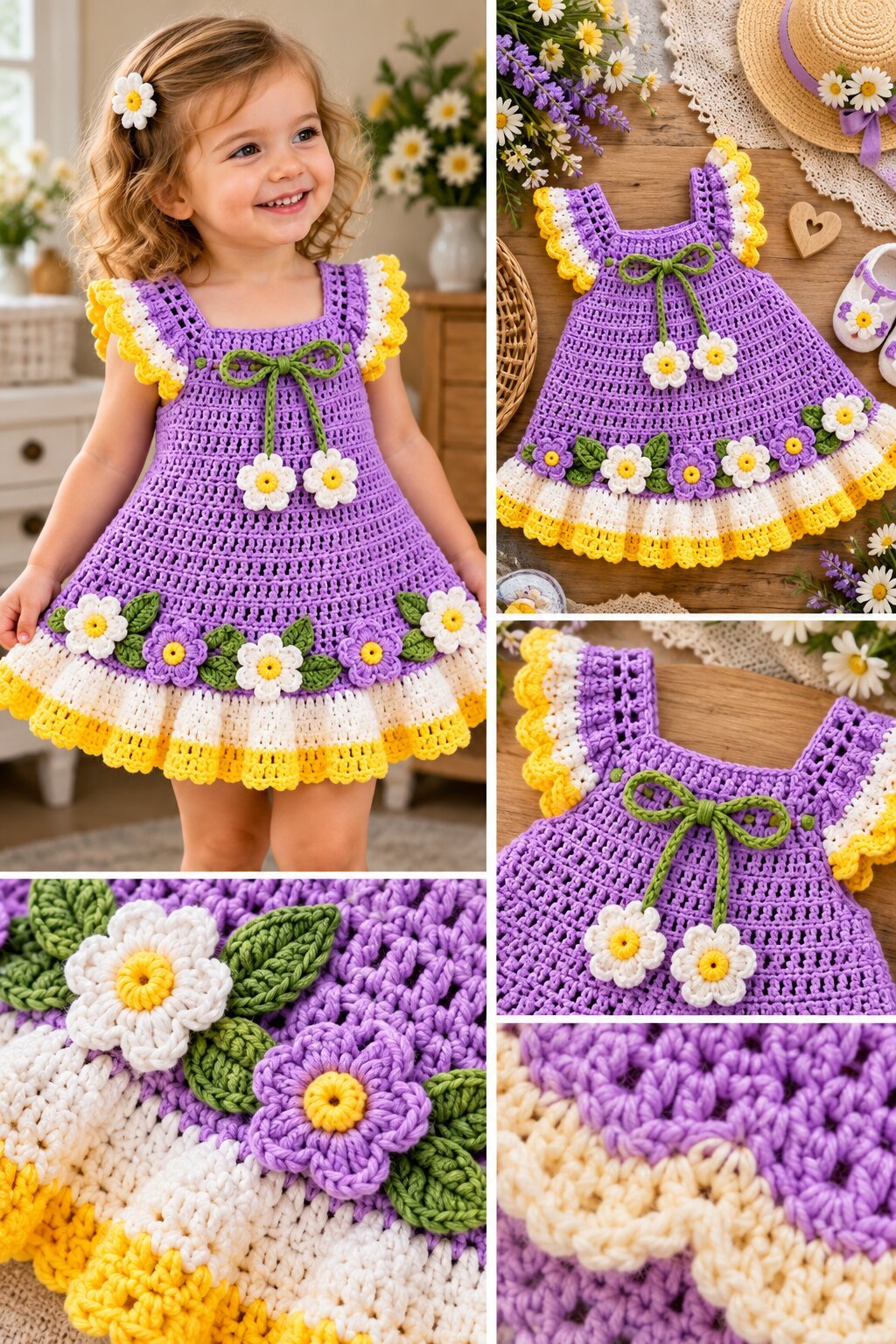
A violet sundress with a square neckline, short flutter sleeves, and a skirt that widens into a gentle A-line. The bodice and skirt are worked in an open, ladder-like mesh of tall stitches and chain spaces, with rows of small rectangular holes running evenly around the body. Each sleeve is a small ruffle layered in purple, cream, and yellow, finished with a yellow scalloped edge. At the chest, a thin green cord is tied in a bow, with two short tails ending in white daisies with yellow centers. Near the hem, a row of white daisies, purple flowers, and green leaves runs around the skirt, above a deep ruffle of cream and yellow bands finished with a scalloped yellow edge. The flat-lay also shows a straw hat with a lilac ribbon and daisies, and white booties with a daisy at the toe.
This post covers what the photos show and how you could build something similar. Sizes and materials below are starting points, since the images show the finished dress and not the original instructions. Because the project name says “Purple,” this is one case where the photo and the name match.
How the dress is built
Four sections make this easier to plan.
Bodice. The upper section looks like rows of double crochet with chain spaces, forming a tidy grid. The neckline is square and the shoulders are wide, flat straps that continue straight from the bodice. A firmer round of single crochet around the neck and armholes would give the clean outline you see.
Skirt. The mesh continues from the bodice, and the dress widens through regular increases, probably placed at a few points around the circumference. The result is a soft flare, not a gathered skirt. Because the rows of holes stay straight, the increases appear to be tucked into the pattern rather than concentrated in visible seams.
Ruffle hem. The bottom third changes character: the open mesh gives way to a denser, textured band in cream, then yellow, finishing in a scalloped yellow edge. The ruffled look suggests extra stitches were worked into each stitch of the previous round, so the fabric has to wave to fit. A similar effect could be made by working two or three stitches into every stitch for a round or two, then adding a final round of shells or small clusters in yellow.
Sleeves. Short ruffles, layered in purple at the shoulder, cream in the middle, and yellow at the outer edge. They look like small fans worked in rows, with extra stitches at the outer edge, then edged with scallops.
The daisy and flower trim
The decorative band above the ruffle is made of three kinds of pieces, all sewn on after the dress is done.
- White daisies: Five rounded petals around a small yellow center. A comparable method is to work a tiny yellow ring in the round, then add five petals as clusters of tall stitches closed with slip stitches, in white.
- Purple flowers: The same structure in a slightly darker violet, with a yellow center, so they blend with the dress while still standing out.
- Green leaves: Small pointed ovals in two shades of green, worked in rows or around a chain foundation. Tuck them behind the flowers so they peek out on either side.
Lay everything out on the dress with pins before sewing, alternating white and purple blooms with leaf pairs between. The two daisies at the chest are the same size as the hem ones, which keeps the set consistent.
The bow and tails
The bow looks like a thin chain or I-cord in leaf green, tied in a double loop with two tails. Each tail ends in a daisy. Small green dots on either side of the bow look like tiny bobbles or French knots that anchor the cord to the fabric.
For a baby garment, it’s wiser to treat the bow as decoration only. Sew the cord down along its full length, so there are no free loops or long tails.
Yarn and hook suggestions
- Yarn: Soft cotton or cotton blend in sport or DK weight is a sensible choice for baby wear, since it’s breathable and washes well. You’ll need a bright violet as the main color, plus cream, sunny yellow, white, a small amount of two greens, and a little extra violet for the flowers.
- Hook: A starting point is 3.0 to 4.0 mm. Use a larger hook for the open mesh and a smaller one for the ruffle band if you want it denser. A 2.5 to 3.0 mm hook works for the flowers.
- Other supplies: Tapestry needle, stitch markers, and a button or snap for the back closure.
Swatch the mesh and the ruffle band separately, since they’ll have different gauges and the ruffle needs its own test to see how much it waves.
Sizing and fit
Use the child’s actual chest, shoulder-to-waist, and shoulder-to-knee measurements instead of age labels, because children of the same age vary a lot.
- Keep the bodice slightly loose, so it doesn’t restrict movement.
- Add a back opening with a button or snap so the dress can go over the head.
- Make the skirt a bit longer than needed. Shortening is easier than lengthening.
- Leave the sleeve ruffles loose, since tight sleeves are uncomfortable for babies.
Customization ideas
- Color: Pale pink with cream and mint, or sky blue with white and yellow, keeps the structure and changes the mood.
- Flowers: Fewer, larger daisies give a bolder look. Skip the purple flowers for a simpler white-only trim.
- Hem: A single color ruffle is faster than the banded one.
- Matching set: The hat and booties in the flat-lay use the same daisies, so leftovers go a long way.
Safety notes
The flowers, leaves, and bow are small parts that can come loose. Sew each piece on at several points with doubled yarn, and tug gently to test. For infants and young toddlers, keep the number of appliqués low, or embroider the flowers directly onto the fabric. Skip free-hanging cords entirely, and sew the bow flat. Check all trims regularly for loose threads.
Care and finishing
Choose machine-washable cotton or acrylic if the dress will be worn often. Block it flat to open the mesh and shape the ruffle, and dry flat. Press the flowers gently while damp to keep their shape.
Frequently asked questions
Is this beginner-friendly?
It combines mesh, shaping, a ruffle, and small appliqués, so it suits someone with some garment experience. A beginner could try the dress without the sleeves or flowers.
How much yarn will I need?
That depends on size and gauge. Estimate from your swatch, and buy a little extra violet, since it covers most of the dress.
Can I make it without the ruffle hem?
Yes. Finish the skirt with a simple scalloped round and keep the flower band.
Can I make it longer?
Add rounds of mesh before the ruffle band begins.