
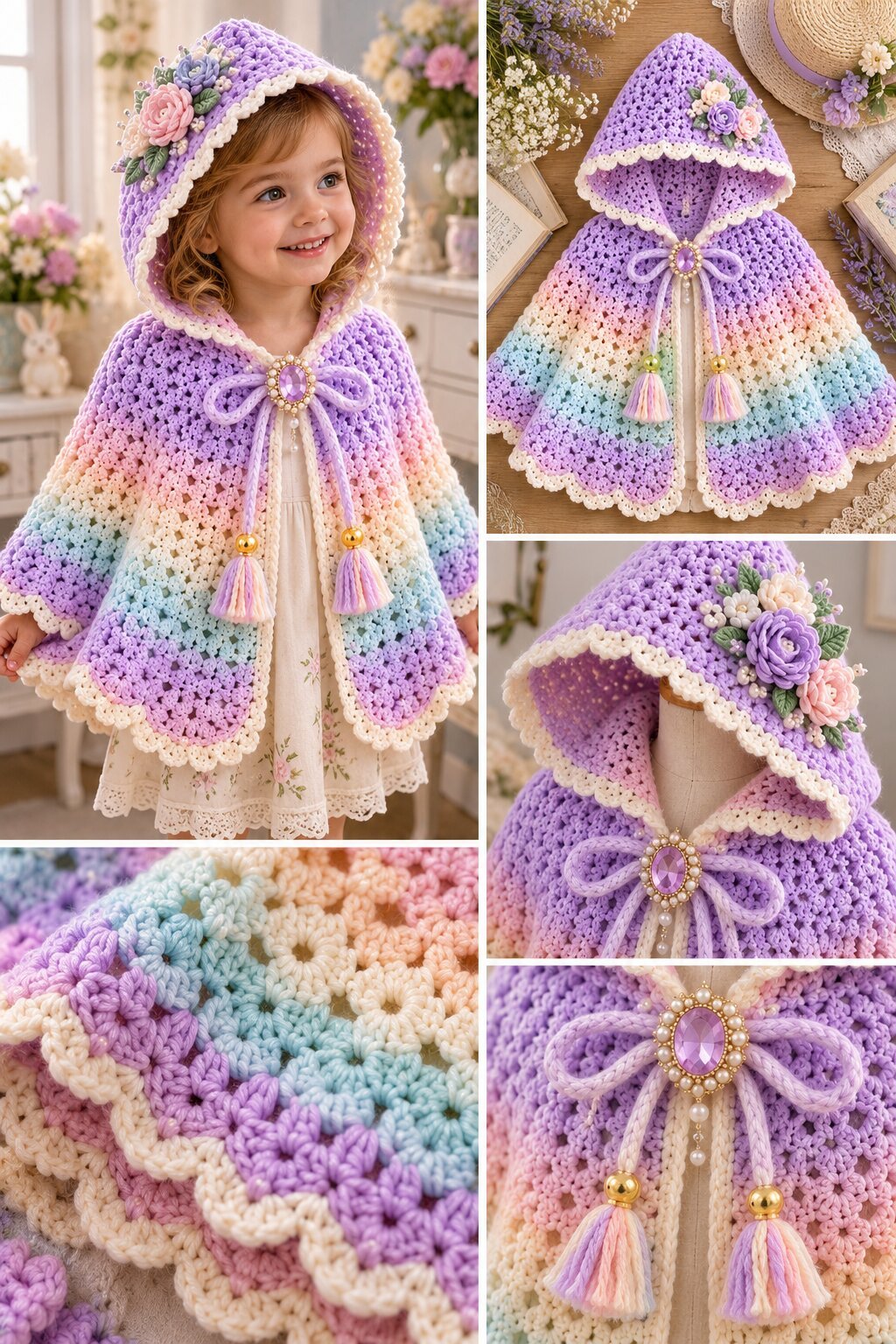
A child-sized cape drapes from the shoulders in horizontal bands of color: deep lavender at the top, fading through pink, peach, and cream, then into soft blue, and back to lavender at the hem. The hood is lined in lilac and trimmed with cream scallops, and a cluster of crocheted flowers sits on one side, a lavender rose at the center with pink and cream blooms and green leaves around it. The cape opens down the front, with cream scalloped edging on both sides and around the hem. At the neck, a looped bow made from thick lavender cord holds a pearl-framed oval gem, and two long cords end in multicolor tassels with gold beads.
This post covers what the photos show and how you could build something similar. The sizes and materials below are starting points, since the images show the finished cape and not the original instructions.
How the cape is built
Four parts make up the design, and they’re easier to plan separately.
Body. The fabric is an open cluster stitch, like a granny or shell pattern, with groups of stitches separated by chain spaces. The cape flares from the shoulders, so it was probably worked from the neck down, with increases at set points so the lower edge gets wider. Increases at the shoulder lines and at the front edges would give the gentle bell shape you see in the flat-lay.
Color bands. The bands are broad, about the height of several cluster rounds each. The close-up shows soft blends instead of hard stripes, which suggests either a long-gradient yarn or several shades changed every few rounds. Both can create this look.
Hood. It appears to be worked separately or picked up from the neckline, then folded and seamed along the back. The inside shows a different shade from the outside, so the lining is likely part of the same color sequence, visible because the hood is folded back.
Edging. Cream scallops run around the hood opening, down both front edges, and along the hem. They look like shells or clusters worked into the final round, which also firms up the edge so it doesn’t curl.
Working the color bands
The pastel rainbow is the main feature, and there are two sensible ways to get it.
- Hand-changed colors: Choose five or six shades and work a set number of rounds in each. Lavender, pink, peach, cream, light blue, and back to lavender would match the photos. Work the first stitch of the new color in the last stitch of the old one to keep transitions clean.
- Gradient yarn: A long-gradient yarn blends the colors automatically. It’s faster, but you can’t control where each shade lands, so the bands may not look the same on both sides.
If you go the hand-changed route, keep each band the same number of rounds on both fronts so the cape looks balanced. Weave in ends as you go, because dozens of ends at the finishing stage is a long afternoon.
The flower cluster
The hood decoration is a small bouquet: one large lavender rose, a pink bloom, a cream bloom, small pearl-style beads, and olive leaves. Judging from the close-up, the roses look like layered spirals of petals, which could be built by working successive petal rounds, each larger than the last, and curling them by hand. The smaller flowers can be simple five-petal motifs, and the leaves can be small pointed ovals worked in rows or around a chain.
Pin the arrangement before sewing. A cluster tilted toward one side, as in the photos, looks more natural than a centered one. Sew each piece on at several points with doubled yarn.
The tie closure
The cape closes with a bow made from thick, rounded cord, in a loop shape, anchored behind an oval gem in a pearl setting. Two cords hang below, ending in tassels with gold beads and a few pearl drops.
- The cord: An I-cord or a long chain worked in slip stitches, doubled for thickness. Make the loops and tails from the same length so they match.
- The tassels: Wrap multicolor yarn around a piece of cardboard, tie one end, and bind near the top. Using the cape’s own colors ties the whole piece together.
- The brooch: A sew-on oval gem with a pearl surround, which is a purchased component. For a child, see the safety section before using it.
Yarn and hook suggestions
- Yarn: A soft, smooth cotton blend or acrylic in DK or light worsted weight gives the drape you see. Avoid anything stiff, since the cape needs to hang and swing. Choose lavender as the main shade, plus pink, peach, cream, light blue, and a little green for the leaves.
- Hook: A starting point is 4.0 to 5.0 mm. Go up a size if the cluster stitch looks tight. The fabric should be open, not dense.
- Other supplies: Tapestry needle, stitch markers, cardboard for tassels, beads, and one or two buttons or snaps if you want a hidden closure behind the tie.
Swatch the cluster stitch in two colors before committing. Check how the color change looks and whether the fabric drapes well when you hold it up.
Sizing and fit
Measure the child’s shoulder width, the distance from the neck to where the cape should end, and the head circumference for the hood. Children of the same age vary a lot, so use measurements, not age labels.
- Make the hood roomy enough to pull up over hair or a hat.
- Keep the neckline loose, so there’s no pull on the throat.
- Add extra length at the hem. Capes are forgiving about this and it’s easy to shorten.
- Make sure the arms can move freely. The wide fall of the cape helps.
Customization ideas
- Color: A cool palette of blue, teal, and cream, or a warm one of rust, mustard, and ivory, uses the same structure.
- Hood: Skip the flowers for a simpler version, or add a pompom at the point.
- Length: Add or remove rounds before the hem edging.
- Size: Increase the number of rounds for a larger child.
Safety notes
Hooded garments and ties need extra care for children. Cords at the neck can be a strangulation risk, especially during play or in playground equipment, so keep them short, or replace the tie with a button or snap closure and sew the bow on as decoration only. The sew-on gem, pearls, gold beads, and flowers are small parts that can come loose, so for toddlers, use embroidered or crocheted flowers and skip the beads. Stitch every piece on at several points, and check them regularly. Remove the cape before car seats or sleep.
Care and finishing
Choose machine-washable yarn if the cape will be worn often. Block it flat to even out the bands and set the scallops, and dry flat. Handle the flowers gently while wet to keep their curl. Store folded to avoid stretching the shoulders.
Frequently asked questions
Is this beginner-friendly?
It uses a repeating cluster stitch with color changes and some shaping, so it suits someone comfortable with garments. A beginner could make a smaller, plain version without the hood flowers or tassels.
How much yarn will I need?
That depends on size, hook, and number of rounds. Estimate from your swatch, and buy a little extra of the lavender, since it appears at the top, the hood, and the hem.
Can I make it without the hood?
Yes. A simple collar or a plain neckline works.
Does it have to be a gradient?
No. A solid lavender cape with the cream scalloped edge would look clean too.