
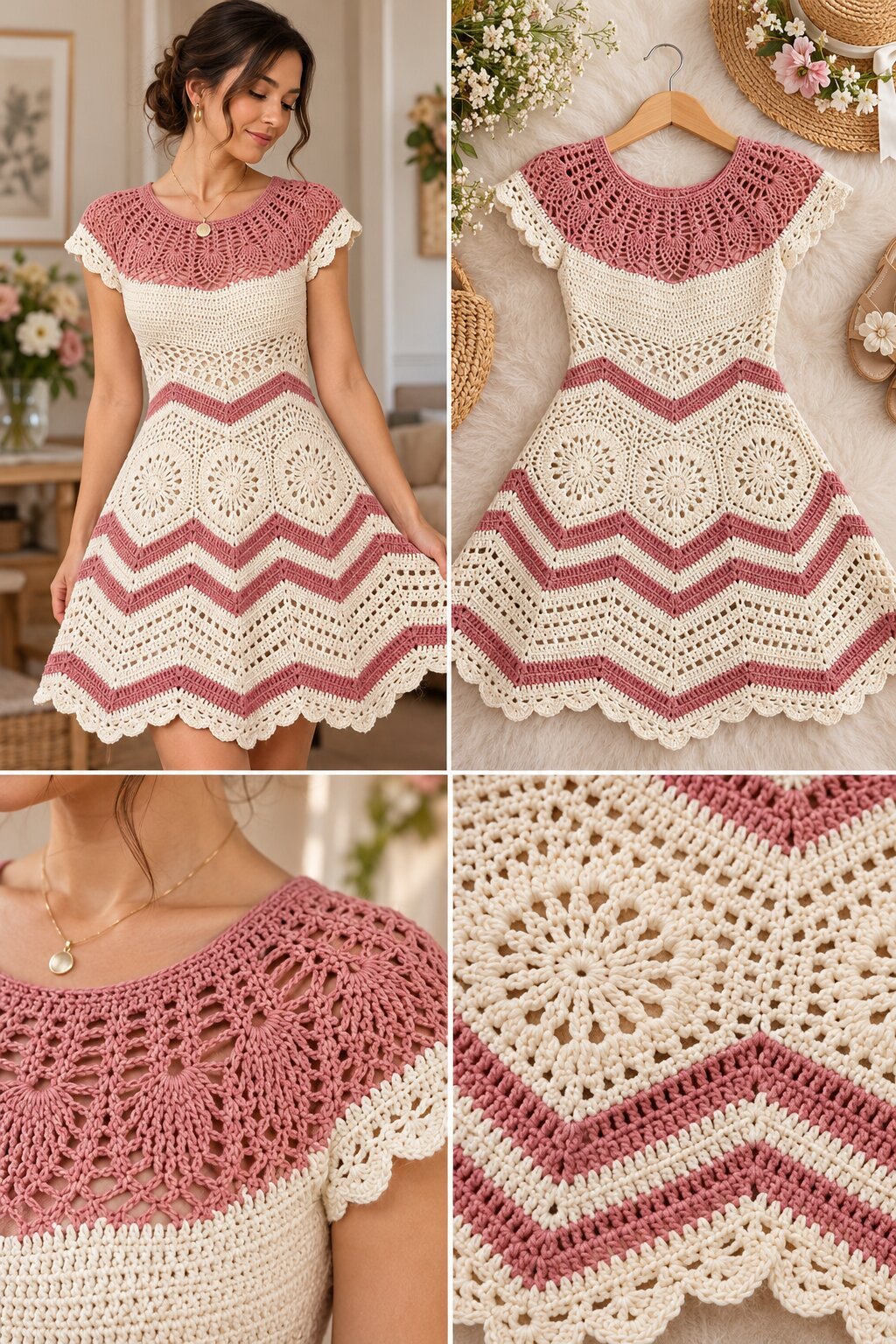
A round lace yoke in dusty rose, worked in a radiating fan pattern like a pineapple or peacock-feather stitch, sits across the shoulders and chest of this cream dress. Below it, a fitted cream bodice in a dense stitch gives way to a narrow band of open mesh at the waist, and then the skirt takes over: three large hexagonal medallions across the front, followed by bold rose-and-cream zigzag stripes that widen as they fall toward a scalloped cream hem. Short flutter sleeves in cream carry the same scalloped edge.
The dress is really three different crochet ideas stacked on top of each other: a lace yoke, a fitted bodice, and a chevron skirt. Each one changes the texture, and each change happens at a clear seam line. The rose color appears in only two places, the yoke and the chevron stripes, so the eye connects them even though they sit far apart.
It suits someone who has made a lace yoke or a ripple blanket and wants to combine them into a garment. Neither technique is exotic, but joining them with a waist that actually fits is the real work.
Reading the Construction
The yoke looks like it was worked in the round from the neckline down, with the fan clusters increasing in number as the circle widens. That is the usual way a lace yoke is built, and it explains how the shoulders and sleeve caps flow without a seam. The edge of the yoke meets the cream bodice in a clean horizontal line, which suggests a color change and a switch to a denser stitch at that round.
The bodice looks like plain rows or rounds of a close stitch, probably single or half double crochet, followed by a band of open mesh. That mesh is likely where the dress takes up or releases width, since lace is easier to ease than a solid fabric.
The skirt is the most interesting part. The hexagon medallions at the top of the skirt look like flat motifs with a round center and radiating spokes, joined side by side across the front. Below them, the zigzag stripes look like a ripple or chevron stitch, where increases and decreases at regular points make the fabric peak and dip. The fullness of the skirt probably comes from adding more repeats as it widens, rather than from gathering.
Materials You’ll Need
- Cream yarn for the bodice, skirt, sleeves, and hem (a cotton or cotton blend is a reasonable suggestion, since it holds crisp lace and ripple lines)
- Dusty rose yarn for the yoke and the zigzag stripes, in the same weight as the cream
- A crochet hook sized to your yarn (see below)
- Yarn needle for joining medallions and weaving in ends
- Scissors
- Stitch markers, useful for marking ripple peaks and valleys and the yoke increase points
- A tape measure, since fit depends on your own measurements
Yarn and Hook Notes
The stitches look fine to medium in weight, so a DK cotton is a sensible starting point, with a hook roughly in the 3mm to 4mm range. Lace and chevron both need a swatch that is blocked before you measure gauge, because open stitches relax noticeably. Keep both colors in the same weight, since a heavier rose yarn would pull the stripes out of line with the cream.
Skill Level
Intermediate. The yoke fan stitch and the ripple stripes are repetitive once the rhythm is established. The harder parts are joining the three medallions neatly, keeping the chevron peaks aligned as the skirt widens, and making the transitions between yoke, bodice, mesh, and skirt sit cleanly.
Stitches Likely Involved
- Chain (ch): spaces in the mesh band, the medallion spokes, and lace arcs
- Slip stitch (sl st): joining rounds and medallions
- Single crochet (sc): bodice, edgings, and anchoring points
- Double crochet (dc) and treble crochet (tr): the fan clusters and ripple stripes
- A fan or pineapple-style stitch: the yoke
- A ripple or chevron stitch: the zigzag stripes
- Magic ring: starting the hexagon medallions
- Shell or scalloped edging: the hem and sleeve borders
- Increase (inc) and decrease (dec): shaping the yoke and ripple peaks
Building It: A Practical Sequence
Swatch the yoke fan and the ripple stitch and block both before deciding on hook size.
Work the yoke from the neckline down, increasing evenly so the fans spread symmetrically. Try it on and check the depth before leaving it.
Switch to cream for the bodice and work it to your waist measurement, then add the open mesh band.
Make the three hexagon medallions and join them side by side, sized so their combined width matches the skirt top.
Work the skirt below the medallions in the ripple stitch, alternating rose and cream rows so the stripes build into zigzags, and widening the repeat count as the skirt flares.
Finish with the scalloped hem in cream.
Add the sleeves. Work short caps from the armholes and finish with a matching scalloped edge.
Weave in ends and block firmly. Lace and ripples both need pinning so the peaks sharpen and the scallops open.
Adjusting the Fit and Look
Bust and waist fit come from your own measurements and gauge. The mesh band is the forgiving spot if you need to adjust. Skirt length is easy to change by adding or skipping ripple stripes before the hem. For a simpler version, replace the medallions with more ripple rows.
The same construction works in sage and cream, navy and white, or two shades of one color for a softer look.
Where It’s Easy to Go Wrong
Ripple peaks that drift. If a stitch count is off, the zigzags lose alignment. Mark peaks and valleys with stitch markers.
Medallions that vary in size. Make them in one sitting with the same tension so they join cleanly.
A yoke that curls. Unblocked lace often rolls at the edge. Block it flat before joining it to the bodice.
A waist that pulls. The transition between dense bodice and open skirt can pucker. Check the fit on your body before moving on.
Colors that bleed in the wash. Dark rose can transfer onto cream. Test the yarn for colorfastness before you commit.
Care
Hand wash in cool water and lay flat to dry, reshaping while damp. Keep the dress away from high heat, and follow the yarn label. Wash separately the first few times in case the rose dye runs.
Common Questions
Is this a good beginner project?
Not really. The lace yoke, medallion joining, and ripple shaping are better suited to intermediate crocheters.
Can I skip the medallions?
Yes. Continuing the ripple stripes up to the waist simplifies the dress, though the medallions are a major part of the look.
What yarn weight should I use?
DK cotton is a reasonable starting point. A thicker yarn would make the lace heavier.
Can I make it longer?
Yes. Add more ripple stripes before the hem.